First-Time Botox®: What to Expect Before, During, and After
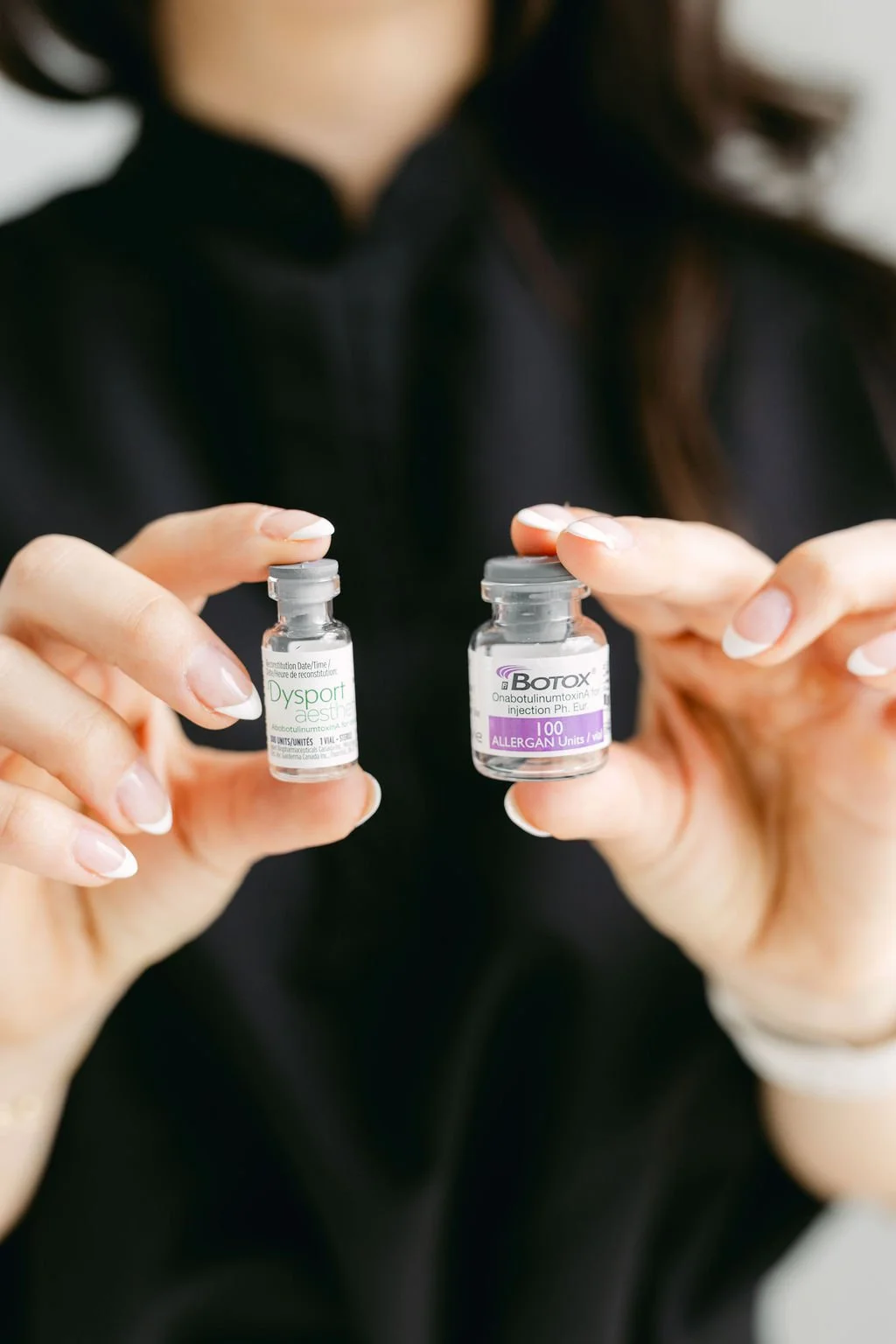
Licensed Nurse Practitioner Cassandra Cimino holds a bottle of Dysport and a bottle of Botox at her medical spa in St. Catharines
You've been thinking about Botox® for months. Maybe longer. You've googled it at least a dozen times, zoomed in on your forehead in the car mirror, and scrolled through enough before-and-afters to make yourself more confused, not less.
And every time you get close to actually booking, the same thought creeps in: what if I come out looking frozen?
That's the fear that keeps most first-timers stuck in the research loop. Not whether Botox® works. Whether they’ll still look like themselves after the appointment.
I get it. And I'm going to walk you through exactly what happens at a first-time appointment so you know what you're walking into, what it feels like, and what the next few weeks look like. No sugarcoating, no sales pitch.
First, Let's Clear Something up
Botox® is not filler. This is the most common mix-up I hear from first-timers, so let's sort it out before we go any further.
Filler adds volume. It goes under the skin to plump areas like lips, cheeks, or under-eye hollows.
Botox® is a neuromodulator. It temporarily relaxes the muscles that cause lines when you squint, frown, or raise your eyebrows. Forehead lines, the vertical "11s" between your brows, crow's feet. Those are all caused by repeated muscle movement, and Botox® softens that movement so the lines stop deepening.
Your face still moves. You still make expressions. The muscles just aren't clenching as hard, so you look like you got eight hours of sleep and nothing is stressing you out.
That's the goal. Not frozen. Rested.
What Happens at the Consultation
Here's where a first appointment at Contour Medical in St. Catharines looks different from what you might expect.
I don't hand you a menu. I don't ask you to point at a chart and pick your areas. Instead, we sit down and talk. I ask you what's bothering you. What you notice in photos. What you're hoping for.
While we're having that conversation, I'm reading your face.
Not in a vague, intuitive way. I'm watching which muscles fire when you raise your eyebrows, how your forehead compensates when you squint, whether one side pulls differently than the other. Your facial anatomy is specific to you, and where I place the product, how many units I use, and which product I choose all depend on what I see your muscles doing in real time.
This part matters more than most providers let on. A forehead isn't a forehead isn't a forehead. Your muscle pattern is yours. Treating it the same way I treat someone else's would be lazy, and you'd see the difference in the result.
I also review your medical history. As a licensed nurse practitioner, I'm trained to understand vascular anatomy, medication interactions, and contraindications. If something about your health history changes the approach, I catch it before we start.
Then I tell you exactly what I'd recommend, how many units, what it'll cost, and why. If I think you don't need something you asked about, I'll tell you that too.
No pressure to move forward that day. But most first-timers do, because by that point the mystery is gone.
What The Actual Treatment Feels Like
This is the part everyone wants to know and nobody describes honestly.
It's a series of small injections with a very fine needle. Each one takes a few seconds. The sensation is a quick pinch, like a tiny flick against your skin. It's not painless, but it is genuinely mild. Most people don't need numbing cream.
The whole treatment takes 15 to 20 minutes. That's it.
You'll sit in the chair, I'll mark the injection points, clean the area, and we'll go through each spot. I talk you through the entire thing. No surprises, no sudden needles while you're mid-sentence.
Here's the thing nobody tells you: most first-timers sit up afterward and say, "Wait, that's it?" The anticipation is almost always worse than the reality.
Right After Your Appointment
You walk out and go about your day. Seriously. No downtime. You can go back to work, pick up groceries, whatever your afternoon looks like.
A Few Guidelines For The First 24 Hours:
- Don't lie flat for about four hours (so the product stays where I put it)
- Skip intense exercise for the rest of the day
- Don't rub or massage the treated areas
- Avoid alcohol the night before and the day of (it increases bruising risk)
Some people get a tiny bump at each injection site that fades within an hour. Mild redness. Occasionally a small bruise, though I use techniques specifically to minimize that. Most first-timers are surprised by how little evidence there is that anything happened.
You could get Botox® on your lunch break and nobody at the office would know.
Who Should Wait or Check First
Botox® is safe for most people, but there are a few situations where it’s not the right call, or where we’d need to adjust the plan.
You should hold off and talk to your doctor (or bring it up during our consultation) if you:
- Are pregnant or breastfeeding
- Have a neuromuscular condition like myasthenia gravis or ALS
- Take blood thinners or muscle relaxants
- Have an active skin infection in the treatment area
- Have had an allergic reaction to botulinum toxin products before
As a nurse practitioner, I screen for all of this during your consultation. It’s part of the medical history review, and it’s one of the reasons that having a licensed NP doing your injections matters. I’m trained to catch the things a cosmetic-only provider might miss.
If you’re seeing someone other than me, make sure they ask about your full medical history before picking up a needle. If they don’t, that’s a red flag.
When You'll Actually See Results
This is where patience comes in.
Botox® doesn't work instantly. The muscles start to relax within 3 to 7 days. You'll notice it gradually. One morning you'll raise your eyebrows in the mirror and realize the deep creases aren't showing up the way they used to.
Full results settle in around the two-week mark. That's when everything has fully taken effect and you can see the complete picture.
I follow up at two weeks. Not as a courtesy, but because that's the point where I can see how your muscles responded and fine-tune anything that needs adjusting. If one brow needs a touch-up or the frown lines could use a small boost, that's when we handle it.
Results last 3 to 4 months for most people. Some clients are at the lower end of that spectrum due to things like age, metabolism, and environmental factors, while others may experience a slightly longer duration. Consistent treatments tend to last longer than sporadic ones.
Let's Talk About the Fear of Looking Frozen
I hear this from almost every first-timer. It's the number one concern. And it's a completely valid one, because you have seen bad Botox®. We all have.
Here's what causes that frozen, shiny, expressionless look: too many units, placed without regard for how the individual's muscles actually work. It's what happens when someone follows a template instead of reading your face.
Good Botox® doesn't look like Botox®. It looks like you on a really good day. The kind of result where your friend says "you look great, did you change your hair?" and you just smile.
My approach is conservative on purpose. I'd rather you come back in two weeks saying "can we add a little more?" than walk out wondering if you got too much. You can always add. You can't take it away.
That philosophy isn't just a preference. It's how I protect first-timers from the exact outcome they're afraid of.
Why I Carry Three Different Neuromodulators
Most clinics carry Botox® and maybe one alternative. I carry Botox®, Dysport®, and Nuceiva® because they're not interchangeable, even though they do the same basic thing.
Botox® stays precisely where you put it. That makes it ideal for targeted areas like the frown lines or crow's feet. Botox is also used most often for medical treatments, as it is the FDA-approved neuromodulator for the treatment of hyperhidrosis (excessive sweating) and migraines, which is typically covered by most private insurance plans.
Dysport® spreads a bit more and kicks in faster, usually within 2 to 3 days. That spread is actually an advantage for larger areas like the forehead, where you want smooth, even coverage.
Nuceiva® is designed purely for cosmetic, anti-aging purposes. Some clients find it feels more natural and lasts slightly longer than Dysport.
Which one I recommend depends on the area we're treating and how your muscles behave. That's a decision I make with you during the consultation, not something that gets decided by whatever product the clinic happens to carry.
A Note on Preventative Botox®
If you're in your late 20s or early 30s and those lines are just starting to form, you're actually in the best position to start. Fewer units, less often, and you're preventing the deep creases from forming in the first place.
Preventative Botox® is its own conversation (and I'll be writing more about it soon). But if that's where you're at, know that starting early isn't overkill. It's strategic.
What Most First-Timers Say Afterward
They wish they hadn't waited so long.
Not because the results are dramatic. Because they're not. That's the point. It's subtle enough that people can't pinpoint what changed, and significant enough that you feel like yourself again when you look in the mirror. Rested. Relaxed. Like the version of you that isn't tired or stressed.
You stop avoiding the front camera. You stop fixating on that one line every time you catch your reflection. It's a quiet kind of confidence, and it tends to snowball.
Ready to Stop Researching and Get Started?
You've done the homework. You know what to expect. The only thing left is sitting down across from someone who'll actually listen to what you want and give you an honest recommendation.
Every consultation and every injection at Contour Medical is me. Not a rotation, not whoever's available that day. The same licensed nurse practitioner who reads your face, chooses your product, and follows up at two weeks.
Your face, your call. I'm here to give you options, not push you into anything.
Frequently Asked Questions About Botox®
-
It's a series of quick pinches with a very fine needle. Not painless, but genuinely mild. Most people don't need numbing cream, and the whole treatment takes 15 to 20 minutes.
-
Results last 3 to 4 months for most people. Consistent treatments tend to last longer than sporadic ones.
-
The muscles start to relax within 3 to 7 days. Full results settle in around the two-week mark, which is when I do a follow-up to fine-tune anything that needs adjusting.
-
Not if it's done well. The frozen look comes from too many units placed without reading your individual muscle patterns. My approach is conservative on purpose. You can always add more at your two-week follow-up. You can't take it away.
-
All three are neuromodulators that relax muscles, but they behave differently. Botox® stays precisely where you put it. Dysport® spreads more and kicks in faster, which is an advantage for larger areas like the forehead. Nuceiva® has a cleaner formulation. Which one I recommend depends on the area and your muscle pattern.
-
You should hold off if you're pregnant or breastfeeding, have a neuromuscular condition, take blood thinners or muscle relaxants, have an active skin infection in the treatment area, or have had an allergic reaction to botulinum toxin products. I screen for all of this during your consultation.